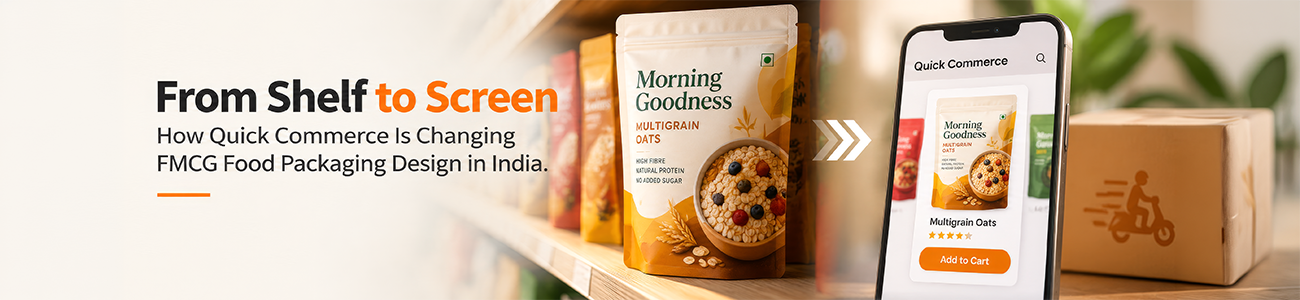
From Shelf to Screen: How Quick Commerce Is Changing FMCG Food Packaging Design in India
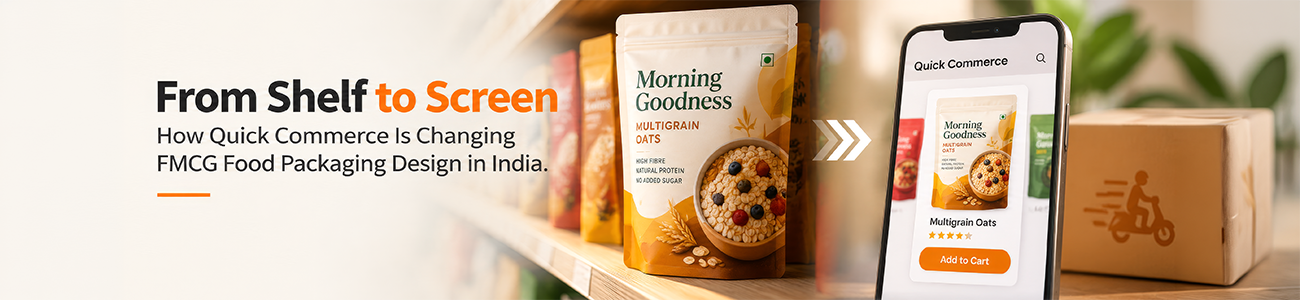
Introduction: The
New Battleground for FMCG Brands
For decades, food packaging was designed primarily to win attention on
supermarket shelves. Brands competed through colours, typography,
illustrations, product photography and distinctive visual identities. A
well-designed package had to stand out among dozens of competing products and
convince shoppers to pick it up.
Today, India's rapidly evolving quick-commerce ecosystem is changing the
rules of product discovery. Consumers increasingly browse groceries, snacks,
beverages and everyday essentials through mobile applications, where products
compete for attention in compact digital listings rather than physical aisles.
This shift has created a new challenge for food manufacturers: packaging
must perform equally well in physical retail environments and on digital
screens.
Modern product packaging design must communicate a brand's identity,
product category, flavour, quantity and key differentiators even when its image
is displayed at a fraction of its actual size. Effective branding and packaging
design must therefore consider both physical visibility and digital
readability.
For food manufacturers investing in growth, the transition from shelf to
screen is no longer simply a marketing trend. It is a strategic consideration
that influences packaging development, product positioning and brand
recognition.
1. The Rise of
Quick Commerce in India's FMCG Industry
Quick commerce has introduced a different way for consumers to purchase
everyday products. Instead of visiting a supermarket or placing a traditional
online grocery order, customers can browse available products through an
application and receive their purchases quickly.
This convenience has created new opportunities for established FMCG
companies and emerging food brands.
However, digital shopping also changes how customers evaluate products.
Consumers may compare several brands within seconds, relying on product
thumbnails, displayed prices, product names, ratings and descriptions to make
decisions.
In a physical store, shoppers can examine packaging closely, read labels
and compare products directly. On a mobile screen, much of this information is
compressed into a small visual space.
This makes product packaging design an important component of digital
brand recognition. A package that communicates effectively at full size may
lose its impact when reduced to a thumbnail.
Brands therefore need to reconsider how they prioritise information,
structure their visual identity and differentiate their products.
Strategic branding and packaging design help manufacturers maintain
recognition across physical stores, quick-commerce platforms, e-commerce
marketplaces and other digital channels.
2. The Thumbnail
Challenge: Can Consumers Recognise Your Product?
One of the biggest challenges in digital retail is maintaining product
recognition at smaller display sizes.
Imagine a consumer browsing several breakfast cereals, spice powders or
packaged snacks on a smartphone. Each product appears as a small image
surrounded by competing brands.
If the product name is too small, the colour palette is indistinct or
the logo lacks prominence, the package may struggle to communicate its
identity.
This is where thoughtful product packaging design becomes particularly
important.
Designers must establish a clear visual hierarchy. The brand name,
product category and most important distinguishing feature should remain recognisable
when the package image is reduced.
Effective branding and packaging design do not mean filling the front
panel with additional promotional messages. Instead, it means identifying the
information customers need most and presenting it in a clear, organised manner.
The same principle applies to FMCG Labelling Design. Although regulatory
declarations must remain accurate and legible on the physical package, the
digital product image should also communicate the product's identity without
unnecessary visual clutter.
Manufacturers should evaluate their packaging at multiple scales before
approving artwork. A design that looks impressive on a large monitor may not
communicate effectively within a mobile shopping interface.
3. Visual Hierarchy
Is Becoming More Important Than Ever
Visual hierarchy determines how consumers process information on a
package. It influences what they notice first, what they understand next and
which details they remember.
For quick-commerce products, designers should establish a strong
relationship between the brand identity, product category, flavour or variant,
and supporting visual elements.
A recognisable logo helps customers identify familiar products. A
clearly presented product name helps new customers understand what is being
sold. Consistent variant colours can make it easier to distinguish between
flavours or product formulations.
Product packaging design should establish these elements before adding
secondary promotional graphics.
For example, a breakfast food manufacturer selling oats, millet flakes
and multigrain cereal should create a consistent packaging system that makes
the product family recognisable while allowing each variant to remain distinct.
The same approach can guide Breakfast Pouch design. A breakfast pouch
needs to communicate its product category, variant and brand identity while
accommodating mandatory declarations, nutritional information and other
relevant details.
Effective branding and packaging design create a balance between
consistency and differentiation. Customers should recognise the manufacturer
across the product range without confusing one variant with another.
4. Why Digital
Visibility Must Influence Packaging Development
Traditional packaging evaluation often focuses on shelf appeal, print
quality, structural performance and brand consistency.
These factors remain essential. However, brands selling through digital
channels should also evaluate how their packaging appears in product-listing
images.
Digital visibility can be assessed through several practical questions.
Can customers recognise the brand when the image is reduced? Is the
product category immediately apparent? Can customers distinguish the flavour
from competing variants? Does the front panel remain visually balanced? Are
important graphical elements lost against the background?
These questions should form part of the product packaging design review
process.
For companies developing new products, this evaluation should happen
before the final artwork is approved. For established brands, it can identify
opportunities to improve the existing packaging system.
Branding and packaging design should also account for the consistency
between the physical pack and its digital representation. Product images must
accurately represent the packaging, including the product name, variant and
relevant visual details.
A digitally enhanced product image should never misrepresent the actual
product or introduce unsupported claims.
5. The Role of
Packaging in Digital Brand Differentiation
Quick-commerce applications frequently display several competing
products within the same category. This makes differentiation especially
important.
Food brands can establish differentiation through distinctive colour
systems, recognisable typography, clear product photography, memorable graphic
elements and consistent brand architecture.
However, differentiation should be based on meaningful brand
characteristics rather than decoration alone.
For example, a regional spice brand may communicate its identity through
a distinctive visual system inspired by its product origins. A healthy
breakfast brand may use a clean layout and carefully selected product imagery
to communicate its positioning. A premium snack brand may use a more refined
design language to distinguish itself from mass-market competitors.
In each case, product packaging design must translate the brand's
positioning into a visual system that works across different retail
environments.
Branding and packaging design should also support future expansion. When
a manufacturer introduces additional flavours, pack sizes or product
categories, the original design system should provide a clear framework for
developing new SKUs.
This approach improves consistency and makes it easier to maintain brand
recognition as the business grows.
6. Regulatory
Compliance Still Comes First
Although digital visibility is becoming increasingly important, it
cannot replace the need for regulatory compliance.
Food packaging sold in India must meet the applicable requirements of
the Food Safety and Standards Authority of India (FSSAI), together with other
relevant legal and technical requirements.
FMCG Labelling Design must account for applicable declarations,
ingredient information, nutritional details, allergen declarations, product
identification, net quantity and other mandatory particulars, depending on the
product category and applicable regulations.
FSSAI Based Cover Design should therefore begin with verified product
information and the relevant regulatory requirements rather than visual styling
alone.
Designers must also distinguish between mandatory information printed on
the physical package and information that can be communicated through digital
product listings. A product thumbnail is not a substitute for the required
declarations on the actual packaging.
For products with complex ingredient lists or specific nutritional
requirements, the artwork should be reviewed by the manufacturer's regulatory
or food-safety professional before production.
The same principle applies when designing Breakfast Pouch design for
cereals, oats, breakfast mixes and other packaged foods. The available space
must accommodate the brand identity and product communication without
compromising mandatory information.
A professional product packaging design process integrates regulatory
requirements from the beginning instead of treating compliance as a final
correction.
7. Quick Commerce
and the Evolution of Packaging Formats
The growth of digital retail may also influence decisions about pack
sizes, product bundles and SKU architecture.
Food manufacturers can evaluate whether their existing formats suit
different purchasing occasions and distribution channels. Smaller packs,
multipacks or family-sized formats may serve different consumer requirements,
depending on the category and business model.
These decisions should be supported by commercial research, consumer
insights, manufacturing capabilities and distribution considerations rather
than assumptions about quick-commerce demand.
Breakfast Pouch design provides a useful example. A manufacturer may
sell single-use breakfast portions, regular household packs and larger family
formats.
Each format requires a clear relationship with the overall brand
identity. Customers should recognise the product family even when the package
dimensions, proportions and quantity differ.
A flexible product packaging design system allows manufacturers to adapt
the layout to different pack formats while preserving essential brand elements.
Branding and packaging design must also consider structural limitations.
A pouch, carton, bottle and flexible sachet offer different printable areas,
proportions and visibility conditions. A design that works well on one format
may need careful adaptation for another.
8. Building a
Digital-Ready Packaging Design System
A digital-ready packaging system begins with a clear set of design
principles.
First, establish the primary visual hierarchy. The brand name, product
category and variant should be easy to identify.
Second, create consistent rules for typography, colours, illustrations
and product imagery. These elements should remain recognisable across the
entire product range.
Third, test the packaging at realistic digital display sizes. Review the
design on mobile screens and alongside competing products rather than relying
exclusively on enlarged artwork previews.
Fourth, verify that all mandatory declarations and approved product
information are accurate.
Fifth, maintain consistency between the final physical packaging and the
digital product images used by retailers.
This systematic approach helps manufacturers reduce avoidable artwork
revisions and create a more consistent customer experience.
FMCG Labelling Design should remain integrated with the broader design
process, ensuring that visual improvements do not compromise mandatory
declarations.
Similarly, FSSAI Based Cover Design must account for the applicable
product-specific regulations while supporting the brand's commercial
objectives.
A successful system combines visual clarity, regulatory discipline and
practical production requirements.
9. Common Mistakes
FMCG Brands Should Avoid
Several recurring mistakes can weaken packaging performance in digital
retail.
The first is excessive front-panel clutter. Too many promotional
messages, decorative graphics and competing visual elements can make the
product difficult to understand at a glance.
The second is weak product differentiation. If multiple variants use
similar visual treatments without clear identifying features, customers may
struggle to distinguish them.
The third is designing exclusively for enlarged presentations. Packaging
must be evaluated at realistic display sizes.
The fourth is inconsistent digital imagery. Outdated product images,
incorrect variants or packaging visuals that differ from the actual product can
undermine customer confidence.
The fifth is treating compliance as a separate task. Regulatory
information should be considered during the initial design process, not added
as an afterthought.
Avoiding these mistakes requires coordination between brand managers,
designers, manufacturers, regulatory professionals and e-commerce teams.
A reliable product packaging design process considers the complete
journey from concept development to physical production and digital product
presentation.
10. Choosing the
Right Packaging Design Partner
As FMCG brands expand across retail channels, packaging development
requires more than attractive graphics. It requires an understanding of brand
positioning, product differentiation, regulatory requirements, print production
and digital presentation.
A capable design partner should be able to translate commercial
objectives into a coherent packaging system.
This includes creating consistent product families, developing adaptable
layouts, maintaining accurate product information and ensuring that the final
artwork reflects the approved design and regulatory specifications.
For food manufacturers introducing new products, professional Breakfast
Pouch design can help establish a distinctive visual identity while
accommodating the practical requirements of the package format.
Similarly, effective FMCG Labelling Design and FSSAI Based Cover Design
require attention to mandatory information, layout constraints and production
accuracy.
Manufacturers seeking a Leading Product Package Designing Company in
India should evaluate the partner's experience, design process, portfolio,
communication practices and ability to manage complex packaging requirements.
The right partnership can help brands establish stronger visual
consistency and develop packaging systems that support long-term product
expansion.
For Rainbowgraph, this represents an opportunity to help food
manufacturers approach packaging as a strategic business asset rather than
simply the final stage of product development.
Conclusion:
Packaging Must Perform Everywhere
The shift from shelf to screen is changing how food brands communicate
with consumers. Quick commerce has introduced a digital environment in which
packaging must remain recognisable, understandable and distinctive even when
displayed at a small size.
This does not make traditional shelf appeal irrelevant. Physical stores
remain important, and packaging must continue to perform in real-world retail
environments.
Instead, the industry is moving towards a more integrated approach in
which product packaging design supports both physical and digital product
discovery.
Successful branding and packaging design combine visual hierarchy, consistent
brand identity, clear product differentiation and regulatory compliance. It
also requires collaboration between designers, manufacturers and digital retail
teams.
For Indian FMCG brands, the opportunity is to build packaging systems
that remain effective across channels without losing the characteristics that
make each product distinctive.
As competition increases, businesses that evaluate packaging across the
complete consumer journey will be better positioned to identify design
weaknesses and improve brand communication.
The future of food packaging is not simply about creating a pack that
looks attractive on a shelf. It is about developing a consistent brand
experience that works wherever consumers encounter the product.