The Regulatory Reckoning in Indian FMCG: Deceptive Wellness Claims, Packaging Obsolescence, and the Strategic Redesign of Food Brands
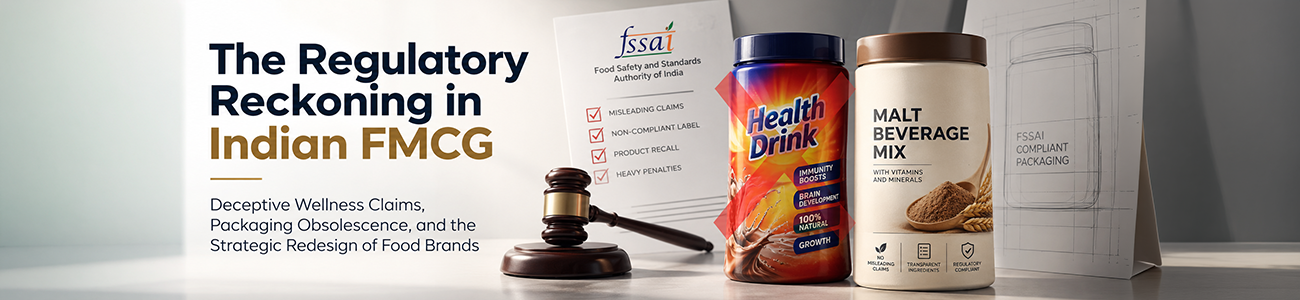
The Regulatory
Reckoning in Indian FMCG: Deceptive Wellness Claims, Packaging Obsolescence,
and the Strategic Redesign of Food Brands
The structural
foundation of fast-moving consumer goods marketing in India is undergoing an
aggressive regulatory correction. For decades, consumer packaged goods
conglomerates operated within regulatory gray zones, relying on hyper-saturated
graphics, pseudo-medicinal front-of-pack claims, and weaponized wellness
terminology to drive retail velocity. That commercial architecture has now
collapsed.
Coordinated enforcement actions
by the Food Safety and Standards Authority of India (FSSAI) and the Central
Consumer Protection Authority (CCPA) have eliminated statutory tolerance for
deceptive packaging. Practices previously dismissed as routine commercial
puffery are now prosecuted as statutory violations, triggering digital
de-platforming, mandatory inventory destruction, and substantial enterprise
liabilities.
Navigating this
transition requires more than cosmetic updates to artwork files. It demands an
urgent operational overhaul across research and development, regulatory
compliance, flexible packaging procurement, and front-of-pack information
architecture. Brand leadership must adapt to a marketplace where marketing copy
is judged strictly against codified food law, and where transparency and visual
discipline have become essential for commercial survival.
1. The Death of the
"Health Drink" Illusion: An Industry Reckoning
The transformation of the
Indian packaged beverage sector began through direct statutory intervention
rather than gradual corporate reform. On March 28, 2024, the FSSAI issued
formal advisory RCD-15001/12/2023-Regulatory-FSSAI-Part (1), directing all
e-commerce Food Business Operators (FBOs) to eliminate dairy-, cereal-, and
malt-based beverage mixes from the commercial categorization of "Health
Drinks". This regulatory intervention was reinforced when the Department
for Promotion of Industry and Internal Trade (DPIIT), under the Ministry of
Commerce and Industry, instructed digital platforms to remove legacy powdered
brands, including Bournvita, Horlicks, and Boost, from health drink search
filters and retail hierarchies.
The legal foundation of this
directive is unequivocal: the term "Health Drink" does not exist
anywhere within the statutory framework of the Food Safety and Standards Act,
2006 (FSS Act, 2006), nor is it defined, standardized, or recognized under any
subordinate rules or regulations promulgated under the statute. The only
standardized beverage classification permitting the functional suffix
"Drink" under the Food Categorization System (FCS 14.1.4.1 and
14.1.4.2) is "Energy Drinks" standardized strictly under
sub-regulation 2.10.6(2) of the Food Safety and Standards (Food Product
Standards and Food Additives) Regulations, 2011, which mandates carbonated or
non-carbonated water-based formulations adhering to precise chemical limits for
caffeine, taurine, and B-vitamins. Marketing high-carbohydrate, malted cereal
powders containing upwards of 40% to 50% sugar under the banner of health
drinks was deemed an act of systemic consumer misdirection.
The FSSAI's intervention gained
momentum following an inquiry conducted under Section 14 of the Commission for
Protection of Child Rights (CPCR) Act, 2005, by the National Commission for
Protection of Child Rights (NCPCR), which investigated the nutritional reality
of proprietary cereal mixes marketed to school-age children. This institutional
scrutiny coincided with independent public fact-checking across digital
platforms. In 2023, public exposure of the sugar metrics within Cadbury
Bournvita revealed that the formulation contained 37.4 grams of added sugar per
100 grams of powder. Despite initial corporate defences and aggressive legal
notices directed at consumer watchdogs, sustained public scrutiny forced
Mondelēz International into a structural reformulation, cutting added sugars by
14.4% down to 32.2 grams per 100 grams by December 2023.
A detailed examination
of category baselines reveals the extent of the reformulation challenge across
legacy brands:
·
Cadbury Bournvita historically
carried 37.4 grams of added sugar per 100 grams, which was reduced
post-controversy to 32.2 grams per 100 grams, leaving total sugars at approximately
46.0 grams per 100 grams under its statutory classification as a Cereal or
Malt-Based Beverage Mix.
·
Horlicks Classic Malt
maintained an unaltered baseline containing approximately 38.0 grams of added
sugar per 100 grams and roughly 46.0 grams of total sugars per 100 grams,
categorized statutorily as a Cereal or Malt-Based Beverage Mix.
·
Complan Royale Chocolate
contained approximately 40.0 grams of added sugar per 100 grams and 45.5 grams
of total sugars per 100 grams, licensed as a Dairy-Based Beverage Mix.
This public confrontation
altered the relationship between Indian consumers and packaged food marketing.
The deference long granted to legacy brands vanished as shoppers realized that
formulations promoted for clinical growth and physical endurance were
ultra-processed foods containing heavy proportions of sucrose, liquid glucose,
and maltodextrin. The commercial era of misleading FMCG Food Packaging
has officially reached its operational limit. The modern regulatory environment
no longer evaluates front-of-pack claims by creative marketing intent, but by
strict statutory defensibility under Indian food law.
2. The Heavy Price
Tag: Dead Cylinders, Obsolete Stock, and Reputational Ruin
When regulatory bodies
issue compliance mandates or invalidate front-of-pack claims, the operational
fallout extends far beyond nominal administrative fines. Non-compliance
triggers severe capital destruction across procurement networks, converter
pipelines, and third-party logistics warehouses.
High-speed flexible packaging
production lines across India depend on rotogravure printing to deliver the ink
densities, line detail, and print speeds demanded by modern retail
distribution. A standard multi-colour barrier pouch requires seven to nine
electronically or laser-engraved steel and copper rotogravure cylinders to
execute the four-color process set (CMYK), corporate brand spot colours, opaque
white barrier foundations, and structural barrier varnishes. Fabricating and
engraving a single precision rotogravure cylinder commands between ₹5,000 and
₹10,000 depending on circumference, face width, and electroplating tolerances.
Consequently, invalidating a single front-of-pack claim requires scrapping an
entire tooling set, inflicting an immediate capital loss of ₹40,000 to ₹90,000
per SKU on cylinder hardware alone.
For an enterprise
operating thirty distinct stock-keeping units across varied package formats,
weights, and regional linguistic variants, an FSSAI compliance notice can
instantly render ₹1.5 million to ₹2.7 million in pre-press tooling assets
unusable. Rotogravure tooling cannot be quickly patched; altering a single
mandatory disclaimer or character height requires stripping the outer chrome
layer, machining the copper down to steel base cores, re-electroplating,
re-polishing, and re-engraving the entire mechanical run.
The write-offs
associated with pre-press tooling are compounded by the immediate obsolescence
of printed packaging inventory. To optimize substrate conversion costs, FMCG
brand procurement protocols enforce converter minimum order quantities (MOQs)
spanning 500 kilograms to multiple metric tons of multi-layer barrier films per
production cycle. Modern flexible barrier packaging relies on multi-material
laminates including biaxially oriented polypropylene (BOPP), metallized
polyethylene terephthalate (Met-PET), high-barrier ethylene vinyl alcohol
(EVOH), and linear low-density polyethylene (LLDPE) sealant webs. Once
converted and printed, these heterogeneous laminates cannot be chemically
de-inked or re-pulped. When a front-of-pack claim is flagged as unlawful,
warehouse inventories of printed flexible film rolls are reduced to
unsalvageable industrial waste.
The operational
breakdown cascades through five distinct enterprise failure points:
1.
Front-of-Pack Claim
Invalidation: Regulators issue a directive or show-cause notice invalidating a
primary promotional claim or category descriptor.
2.
Upstream Tooling Loss: Entire
rotogravure cylinder sets are scrapped, halting packaging runs and idling
factory capacity.
3.
Substrate
Obsolescence: Warehoused barrier laminates cannot be repurposed, generating
substantial balance-sheet write-offs.
4.
Reverse Logistics Disruption:
Regional distribution hubs lock down inventory; manual re-stickering introduces
packaging integrity risks from thermal shock and condensation.
5.
Regulatory Sanctions and Class
Action Exposure: Authorities enforce civil penalties while mandating nationwide
recalls under consumer protection statutes.
To prevent total inventory
write-offs, manufacturers often attempt emergency field re-stickering. Yet
pulling master cartons from warehouses to manually affix corrective labels
incurs costs between ₹0.75 and ₹2.50 per unit in labour, label stock, and demurrage.
Furthermore, exposure to ambient humidity creates thermal shock condensation
that degrades label adhesives, causing peeling in retail transit. A misaligned
corrective sticker signals regulatory failure to consumers, destroying brand
credibility.
Compounding these supply chain
disruptions is institutional liability. Under Section 21 of the Consumer
Protection Act, 2019, the CCPA possesses statutory authority to penalize
manufacturers up to ₹10 lakh for an initial misleading claim, escalating to ₹50
lakh for recurring infractions. Under Section 20, the authority can mandate
total product recalls, forcing manufacturers to absorb reverse-logistics
freight and inventory destruction expenses. Misleading front-of-pack statements
trigger liability under Section 2(28) for misleading advertisements and Section
2(47) for unfair trade practices, exposing consumer brands to collective class
actions and legal vulnerability.
3. Anatomy of a
Crackdown: Deconstructing Illegal Claims on Front-of-Pack
Navigating current regulatory
enforcement requires examining the statutory requirements established by the
Food Safety and Standards (Advertising and Claims) Regulations, 2018 (and its
amendments) alongside the Food Safety and Standards (Labelling and Display)
Regulations, 2020. The regulatory framework leaves no room for ambiguous
marketing terminology across commercial food categories.
Deconstructing
Restricted Front-of-Pack Adjectives and Claims
Under food safety
regulations, promotional claims are governed by strict permissions, numerical
thresholds, and explicit prohibitions:
·
"100% Pure" and
"100% Real": The CCPA and FSSAI have established that
"100%" represents an absolute mathematical statement that permits
zero processing or ingredient qualification. Storia Foods was penalized for
labelling beverages as "100% Tender Coconut Water" when the product
was reconstituted from water and 9.6% concentrate with added potassium sorbate
(INS 202). Placing "(Reconstituted)" in back-of-pack fine print
failed to remedy the violation. Similarly, Mrs. Bectors Food Specialities
(English Oven) was penalized for marketing "100% Atta Bread" that
contained only 87% whole wheat flour blended with refined wheat flour. Meeting
the 75% whole wheat minimum under Regulation 2.6 of the Labelling Regulations
does not permit an absolute "100%" claim.
·
"Natural" and
"Fresh": Schedule V of the Advertising and Claims Regulations, 2018,
restricts "Natural" strictly to single-ingredient foods harvested
from plants, animals, or microorganisms subjected only to minimal physical
processing. Products containing added synthetic preservatives, identical
flavours, or chemical additives cannot use the term. "Fresh" is
prohibited on foods subjected to thermal preservation, pasteurization, chilling
beyond initial post-harvest stages, or chemical extension. Terms like
"Home-made" are banned entirely.
·
"No Added Sugar"
versus "Sugar-Free": In June 2024, the FSSAI prohibited the claim
"100% Fruit Juice" on reconstituted fruit beverages. Concurrently,
claiming "No Added Sugar" is illegal if the formulation incorporates
concentrated fruit juices, purees, or invert syrups that functionally elevate
total sugars. Under Schedule I of the Advertising and Claims Amendment
Regulations, 2021, "Sugar-Free" requires total sugars to test mathematically
below 0.5 grams per 100 grams for solids or 0.5 grams per 100 millilitres for
liquids. "Low Sugar" restricts total sugars to 5.0 grams per 100
grams for solids or 2.5 grams per 100 millilitres for liquids.
·
"Immunity-Boosting"
and "Brain-Development": Under Section 24 of the FSS Act, 2006, and
Regulation 7 of the Claims Regulations, functional physiological claims require
documented scientific substantiation. These statements must identify both the
validated nutrient function and the specific nutrient concentration. Broad
assertions such as "accelerates brain development" or "boosts
immunity" represent therapeutic claims that require formal prior approval
from the FSSAI Scientific Panel.
Architectural Rules:
Display Panels, Typography, and Contrast
FSSAI enforcement
extends into physical label geometry, layout, and contrast under the Food
Safety and Standards (Labelling and Display) Regulations, 2020:
Under Regulation 6, the
Principal Display Panel (PDP) must occupy at least 40% of the largest panel
area for rectangular packages, 40% of the product of container height and
average circumference for cylindrical packages, and 20% of total surface area
for irregular containers.
Under Table 1 of the Labelling
and Display Regulations, 2020, mandatory declarations must adhere to strict
type heights based on the surface area of the Principal Display Panel:
·
For a PDP area up to 200 square
centimetres: minimum type height of 1.0 mm for standard packaging, and 2.0 mm
when blown, formed, moulded, or perforated on the container.
·
For a PDP area greater than 200
square centimetres up to 500 square centimetres: minimum type height of 2.0 mm
for standard packaging, and 4.0 mm for blown, formed, moulded, or perforated
containers.
·
For a PDP area greater than 500
square centimetres up to 2,500 square centimetres: minimum type height of 3.0
mm for standard packaging, and 5.0 mm for blown, formed, moulded, or perforated
containers.
·
For a PDP area exceeding 2,500
square centimetres: minimum type height of 6.0 mm for both standard packaging
and blown, formed, moulded, or perforated containers.
The width of any letter or
numeral must not be less than one-third of its height, excluding the numeral
"1" and the letters "i", "I", and "l".
Under sub-regulation 4(7) of
the Advertising and Claims Amendment Regulations, 2021, if a brand name or
trademark contains restricted adjectives like "Natural",
"Pure", or "Real" that could mislead consumers, the front
panel must carry a mandatory disclaimer: "*This is only a brand name or
trade mark and does not represent its true nature". This disclaimer
requires a minimum font size of 1.5 mm for packs under 100 square centimetres
and 3.0 mm for larger packs.
Mandatory declarations must
also maintain conspicuous contrast against the packaging ground. Printing
low-contrast text over translucent films or coloured backgrounds violates
statutory legibility standards. Complying with FSSAI Guidelines in Food
Packaging requires viewing artwork files as legally audited technical
documents.
4. The Engineering of
Truth: Elevating Product Packaging Design Beyond Buzzwords
The elimination of
deceptive front-of-pack claims creates a strategic commercial opportunity. When
marketing teams can no longer rely on loud starbursts, pseudo-clinical
certification badges, and misleading claims as crutches to mask poor
formulations, the visual burden shifts entirely to disciplined product packaging design.
Mass-market packaging in India
long relied on visual chaos. The front faces of legacy beverage mixes and
packaged foods featured competing visual noise: dynamic energy ribbons, 3D
splash effects, gold certification crests, and exaggerated functional claims.
This cluttered approach signals an ultra-processed product profile, alienating
label-literate consumers who equate visual clutter with artificial ingredients.
It also creates legal exposure under consumer protection legislation.
Modern packaging
strategy points toward structural minimalism, an aesthetic rooted in Swiss
visual order, German functionalism, and Scandinavian design discipline. Termed
"Pharma-Clean," this philosophy strips away decorative graphics,
relying on deliberate spatial hierarchy, clean grids, and unadorned sans-serif
typography such as DIN, Univers, or Neue Haas Grotesk.
Minimalist compositions
treat negative space as an active asset. An uncluttered canvas signals
formulation purity and shelf authority, enabling a product to stand out on
retail shelves crowded with high-saturation competitors. Rather than deploying
ambiguous slogans, high-performance packs highlight verified composition:
"72% Single-Origin Cocoa," "0.0g Added Sugar," or
"Cold-Pressed."
Appetite appeal must be
achieved without crossing into deceptive advertising. FSSAI and CCPA
enforcements penalize packaging imagery that exaggerates ingredient realities.
Featuring orchard-fresh fruits and cascading milk streams on products composed
of reconstituted juice concentrate, water, and preservatives violates Section
2(28) of the CPA, 2019. Compliant appeal relies instead on authentic macro
ingredient photography showcasing real textures, deconstructed flat-lays with
verified ingredient percentages, and refined botanical line illustrations that
indicate flavour profiles without misrepresenting whole ingredients.
5. Strategic
Blueprint: How Modern FMCG Brands Must Execute Branding & Labelling
To maintain regulatory
compliance, preserve capital, and protect brand equity, food and beverage
enterprises must adopt an integrated operating model across four execution
stages:
·
Stage 1: Upstream Formulation
and Statutory Alignment. Product R&D must formulate strictly against
codified commodity standards under the Food Product Standards and Food
Additives Regulations, 2011, rather than relying on loose proprietary food
categorizations. Formulations should align with ICMR-NIN dietary guidelines to
avoid high-sugar and high-sodium thresholds. R&D teams must eliminate
artificial preservatives and processing aids that compromise clean-label
positioning.
·
Stage 2: Packaging Substrate
and Conversion Resilience. Packaging engineering must mitigate tooling
write-offs by standardizing print workflows. Adopting a 7-color Extended Colour
Gamut (ECG) printing framework allows brands to execute multiple SKUs using a
universal cylinder setup, eliminating the need to scrap custom spot-colour
cylinders. Brands should utilize high-definition flexography or digital
roll-fed printing for initial market trials before investing in large
rotogravure runs. For multi-variant lines, pre-printed base barrier pouches can
be paired with inline thermal transfer overprinting (TTO) to adapt statutory
text without discarding flexible films.
·
Stage 3: Information
Architecture Design Sprints. Creative agencies and packaging technologists must
execute branding & Labelling within an audited modular layout. The
Principal Display Panel should dedicate the lower 30% exclusively to statutory
declarations, net weights, and mandatory disclaimers, leaving the upper 70% for
brand identity and product naming. Automated pre-press scripts should verify
that font sizes meet Table 1 height and stroke-width rules prior to cylinder
engraving. Marketing claims requiring fine-print disclaimers should be
eliminated from the front panel entirely.
·
Stage 4: Continuous Post-Print
Regulatory Verification. Packaging pre-press departments must integrate
automated digital inspection tools to verify type dimensions, contrast ratios,
and stroke widths against the FSSAI Labelling and Display Regulations, 2020,
before releasing production files. Cross-functional compliance teams comprising
legal, quality assurance, and packaging leadership must review packaging
artwork against emerging regulatory circulars and CCPA advisories. All
front-of-pack nutritional claims must be validated through analytical testing
certificates from FSSAI-notified, NABL-accredited laboratories and archived for
legal defensibility.
6. The Commercial
Upside of Radical Packaging Transparency
The elimination of the
"Health Drink" classification and the rigorous enforcement of FSSAI
Guidelines in Food Packaging represent a permanent structural shift across
Indian retail. The regulatory framework has invalidated outdated marketing
strategies that relied on misleading nutritional assertions and cluttered
front-of-pack graphics.
While adapting packaging assets,
tooling, and formulations involves near-term operational costs, the strategic
upside is substantial. Modern Indian consumers are increasingly label-conscious
and sceptical of unsubstantiated corporate marketing. By modernizing product
packaging design, establishing disciplined visual hierarchies, and
grounding product narratives in verified formulation data, consumer goods
enterprises can build durable market leadership. In modern FMCG, radical
packaging transparency is no longer a compliance burden it is the ultimate
brand differentiator.